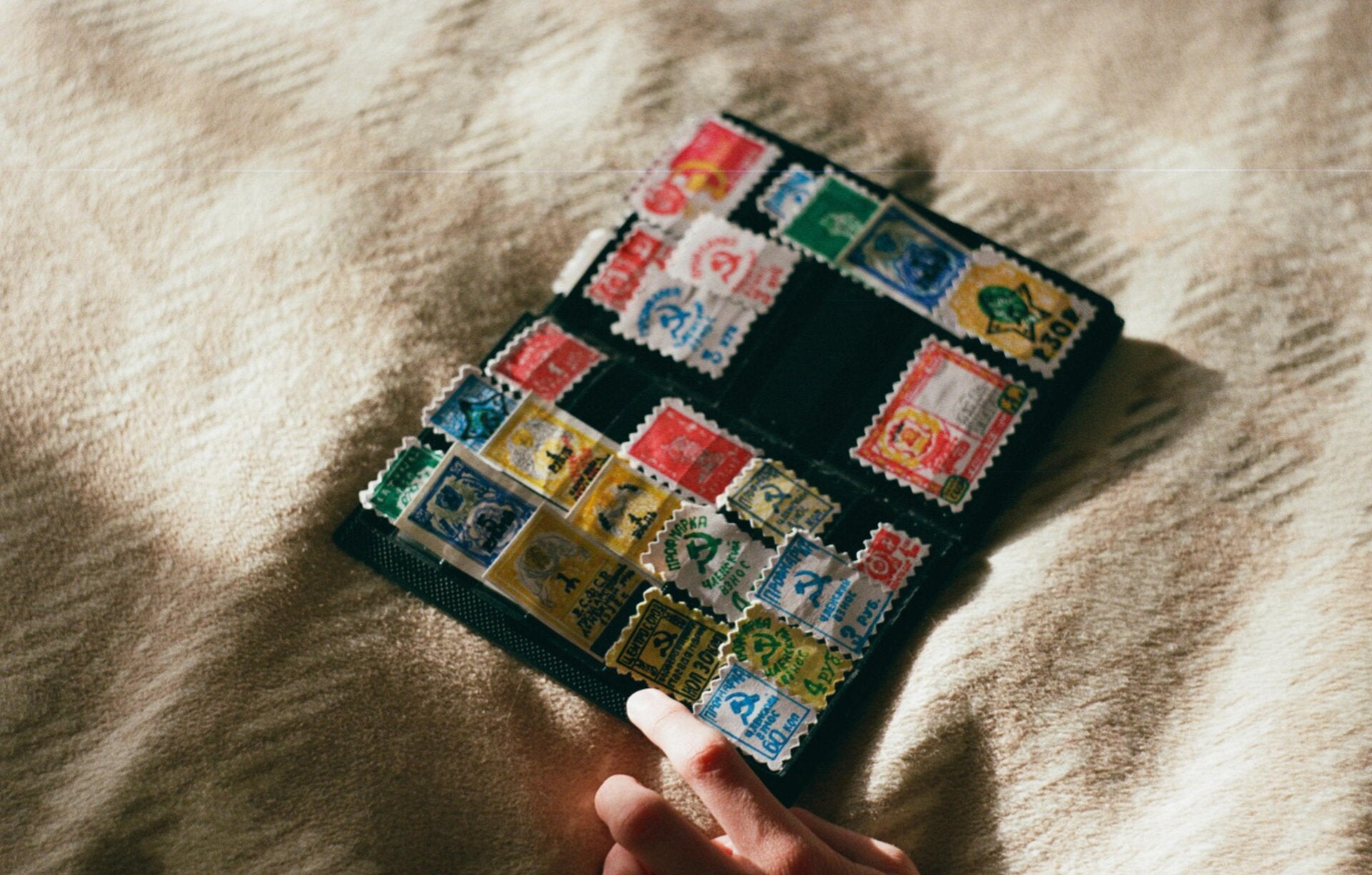
Explore the fascinating world of philately

Welcome to the East Bay Stamp Club, a community for stamp collectors in the San Francisco East Bay area. Meeting in San Pablo, California, we share a passion for philately through engaging meetings, exciting club auctions, and our highly anticipated annual stamp show. Join us to connect, learn, and grow your collection.

The East Bay Stamp Club is more than just an organization; it's a vibrant hub for philatelists of all levels. From rare finds to historical insights, we foster a welcoming environment where members can share their collections, expand their knowledge, and participate in a variety of activities designed to celebrate the art and history of stamps. We're dedicated to promoting the hobby throughout the East Bay.

I've got these stamps. Now what?

Our parents left me these stamps. Or I was rooting around in the closet and found this old stamp album from when I was a kid. The first question is usually "are these worth some money?" Or maybe, "these are kind of interesting. Maybe I'd like to collect some more!"

Here at the East Bay Stamp Club, we often get questions from people asking about their stamps. We're always willing to help! You can contact us at info@ebstampclub.org and tell us what you know about what you have. Sometimes, especially if it's a significant collection, you can bring it to one of our meetings and we can help you determine what the collection might be worth and how best to sell it, if that's your desire. (We also accept donations of stamps, supplies, etc. We try to pass these on to collectors who might be able to use them.)

See our Stamps FAQ on this page for more answers to common stamp questions.

Frequently asked questions about stamps

Do you have questions about stamp collecting, valuing your collection, or how to buy stamps? We've compiled a list of common inquiries to help you find the answers you need quickly. If your question isn't covered here, please feel free to contact us directly. We're always happy to assist fellow philatelists and those new to the hobby!

What determines the value of a stamp?

Basically, supply and demand. That is, how rare or common is the stamp, and how popular is it with collectors? It's not about age. Billions of stamps were printed in the 19th century, and many of them are only worth a few pennies. On the other hand, a recent stamp with a significant printing error might be worth thousands of dollars.


Condition, Condition, Condition ...

As with most kinds of collectibles, condition is very important in determining value. Usually (but not always) a mint (unused) stamp with gum on the back is worth more than one that has been canceled and used for mail.

A stamp whose design is well-centered with even margins is better than one that is off center or has the perforations cutting into the design.

A mint stamp that has all its gum and no sign that a hinge (a small folded piece of glassine) has been used to mount it is more valuable than a stamp that has been hinged.

A stamp that has been creased or has a spot where the paper has been thinned out (perhaps from removing a hinge) may be worth only a fraction of the value of a stamp without such defects.

What about envelopes with stamps on them?

You may encounter old mail with interesting stamps on it. You may be tempted to soak or clip off the stamps. Don't do that without consulting someone knowledgable. Sometimes the whole thing with its postal markings is more valuable to collectors than the stamp alone.

Accumulations and Collections

Although there are exceptions, in general the following is true:

  • A cigar box or similar container with a pile of random stamps (soaked off or attached to little bits of paper) is unlikely to contain much of value
  • A small album, often "worldwide" of the kind kids used to start collecting is unlikely to have stamps of value. These albums were designed for beginners and had spaces only for the most common stamps.
  • Little glassine packets from companies such as Harris or Kenmore  have stamps that are great for beginners but not of interest to most dealers or collectors today
  • Plate blocks (groups of four or six of the same stamp with a number found in the margin). These used to be popular, but are less widely collected today. Many from the 1940s or later are now worth little more than face value.
  • Whole sheets of U.S. stamps, often with denominations of 3 or 4 cents look impressive, but are pretty much worthless (with a few exceptions). These stamps could theoretically be used for postage, but you'd need an awful lot of 3 cent stamps to mail a letter today!
  • A number of impressive looking "collections" have been sold by telemarketers or mail order over the years. These might include lavishly illustrated envelopes with stamps depicting a theme,  "gold" replicas of U.S. stamps, etc.) These are of little interest to today's collectors and have minimal value.

So What Kinds of Collections Might be Valuable?

These are some indications that a collection might have worthwhile value:

  • A United States collection with many 19th century stamps, especially if mint
  • A U.S. collection that includes higher denomination stamps in a given series
  • Higher denominations of early commemoratives such as the 1869 pictorial issue, 1893 Columbian issue or 1898 Trans-Mississippi issue
  • An airmail section that includes the three Graf Zepplin stamps
  • First Day covers with original artwork or illustrated by certain cachet makers
  • A collection of covers illustrating "postal history" or special forms of mail delivery
  • An album that specializes in a single country, such as Britain or France, with many of the early spaces filled with stamps that appear to be in nice condition
  • A large worldwide album or set of albums with many spaces filled. This can turn out to have mainly cheap stamps, but an experienced person can look at certain countries and see if more valuable issues are included.

What about Catalog Value?

Stamp catalogs such as the Scott Catalogue available at many libraries provide a wealth of useful information. (The introductory pages to Scott are an excellent introduction to the elements of the hobby). However, there are some pitfalls to using the catalog to determine values.

  • Values may not keep up with current market conditions
  • In practice, many stamps are sold at considerably less than catalog value, and in turn, the wholesale value (what dealers will pay) may be only a small fraction of catalog value
  • Conversely, if a stamp is in truly superb condition, advanced collectors may pay more than catalog value
  • Determining which catalog entry applies to your stamp can be difficult. Scott may provide several numbers for what looks like the same stamp, but differs in perforations, watermark, or subtle differences in design or printing

Where's the Best Place to Buy Stamps?

How can you start or expand your stamp collection?

In the old days, every city of decent size had one or often several stamp shops where you could walk in and see a variety of stamps and be helped by a (usually knowledgable) dealer. 

Today stamp shops are few and far between. If you want to shop "in person" your best bet is a stamp show like the one the East Bay Stamp Club holds each October. (Also see our listing of other upcoming stamp shows in the Bay Area). Stamp shows give you the opportunity to visit multiple dealers.

Joining your local stamp club will also give you an opportunity, to buy, sell, or swap stamps. (Many clubs including ours also have auctions). See our section "Local Stamp Clubs" on this page for more information.)

We also highly recommend joining the American Philatelic Society (www.stamps.org). They provide many resources for collectors including an online stamps store that is well managed. Another site used by many dealers is Hipstamp (www.hipstamp.com). 

Of course there is also eBay. One has to be more cautious there, though. Many eBay stamp sellers don't understand what they're selling or describe it incorrectly. Prices can range from a good deal to ridiculous. Feedback can help somewhat.

In general, especially for buying expensive items, check out the dealer's references. Are they an APS or ASDA (American Stamp Dealer Association) member?

Finally, if you're buying a stamp that is worth several hundred dollars or more, consider getting it certified to make sure it is not fake or altered. The APS offers "expertizing" services, and there are other firms such as Professional Stamp Experts (PSE). These services can also assign a grade to the stamp.

Bay Area Stamp Clubs

The East Bay Collectors Club meets on Zoom once a month, and in person in San Pablo.  There are several other stamp clubs in the Bay Area that you may want to look into. Perhaps one is more convenient to your location (and there's no law against belonging to more than one!) Several EBCC members are also members of the Alameda Stamp club.

The Alameda Stamp Club meets monthly at the Mastick Senior Center, 1155 Santa Clara, Alameda. They often work with the East Bay Club on our stamp show.

https://sites.google.com/view/alameda-stamp-club/home

For those of you in the southeast Bay, the Fremont Stamp Club meets at the Cultural Arts Center, 3375 Country Drive, Fremont.

http://www.fremontstampclub.org/

On the Peninsula, we have the Sequoia Stamp Club. They meet in the Community Activities Building, 1400 Roosevelt Avenue, Redwood City. They also put on the annual PENPEX stamp show.

http://penpex.org

In the South Bay? Try the San Jose Stamp Club. This well-established group meets monthly at the Pearl Avenue Branch of the San Jose Public Library, 4270 Pearl Ave. The club also puts on the Filatelic Fiesta stamp show annually.

https://sanjosesc.com/

For the North Bay, there is the Redwood Empire Collectors Club. It meets monthly at the Cafe Bellini in Petaluma.

https://www.redwoodempirecollectorsclub.org/about.html

A little further afield is the Sacramento Philatelic Society. It meets at the Northminster Presbyterian Church, 3235 Pope Ave., Sacramento. They put on the SACAPEX show each Fall.

https://sacramentostampclub.org/

 

Upcoming Stamp Shows

October 17-18

East Bay Collectors Club 80th Annual Stamp Show (Walnut Creek)

https://www.ebstampclub.org


November 7-8, 2026

SACAPEX (Sacramento)

http://sacramentostampclub.org/events/sacapex/


November 14-15, 2026

Filatelic Fiesta (Santa Clara)

http://www.filatelicfiesta.org/


December 5-6, 20266

PENPEX (Redwood City)

http://penpex.org


April 23-25, 2027

WESTPEX (Burlingame - the big one!)

https://westpex.org/